


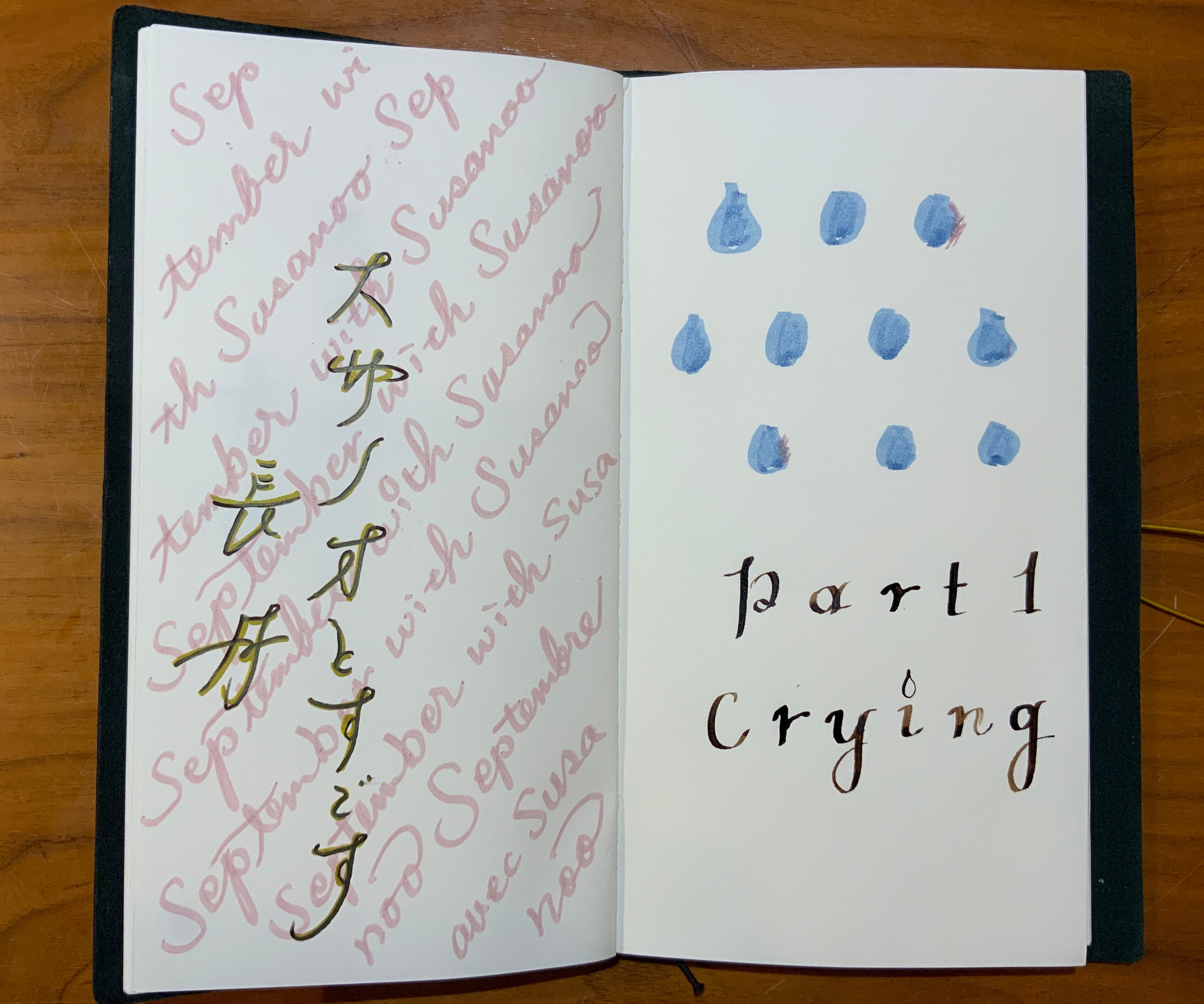
Last month, my boy-girl twins turned eighteen.
The night before, we had held a kind of birthday-eve party and had a wonderfully noisy time together. But on their actual birthday, they both went out with their own friends, and no one was home.
I cleaned the rooms thoroughly, then took a long, leisurely bath by myself. While I was standing under the shower, tears suddenly began to come.
Then they kept coming. I started sobbing out loud.
In the end, I cried for an hour.
Even I was surprised.
I had no idea what was happening.
Eventually, the back of my throat and the back of my head began to hurt terribly, and it was only because of that pain that I finally stopped crying.
Without it, I might have kept going until my own personal hydrological system had completely collapsed.
With my head pounding, I thought:
Ah.
Next month on Substack, I’m going to write about Susanoo.
Susanoo is one of the most popular kami in Japanese mythology. The very first thing he does is cry.
He cries and cries and cries, until his beard grows long.
I opened my computer in the perfectly clean, completely empty kitchen and, before beginning the article, decided to organize the seventy pieces I had written so far. This was the moment.
I don’t have a writing desk of my own. I have a board laid across a space opposite the kitchen oven, and that is where I put my computer.
The articles in Grooving with Kami fall, roughly, into four categories.
1. Shrine Life & Ritual
Daily life at a Shinto shrine: rituals, seasonal events, and the small things that happen in and around the shrine.
Imagine the shrine that appears in a slice-of-life anime.
Then go further inside.
2. Kami, Classics & Ideas
The kami who appear in Japanese mythology, and my own thoughts about what kami might be.
3. Sanpo & Other Mysteries
Records of my everyday walks, along with slightly mysterious stories that one reader once described as “like a cheerful David Lynch.”
I remain extremely pleased with this compliment.
4. Conversations & Q&A
Reader-participation pieces in which I answer questions from readers and students of Shinto, or readers show me their kamidana household altars and goshuinchō stamp books and I comment on them.
✳︎✳︎✳︎
Susanoo has many, many faces. He changes. He does not have one fixed personality. Change who he is with, or change the situation he finds himself in, and another Susanoo appears.
I find myself thinking:
Susanoo is rather like me.
The longer we live, the more many-sided our personalities become, and those different sides are constantly changing. The thing I call “me” cannot exist all by itself. It appears only within relationships. Even now, sitting alone in my kitchen writing these words, I am Toukyo—the person who comes into existence somewhere between myself and my readers.
Perhaps this is not true only of me. Perhaps other people are like this too. Perhaps it is not even limited to human beings. Perhaps it is true of all living things.
So this September, over five installments, let us wander through the world of Japanese mythology and follow Susanoo as he changes.
Before He Becomes a Hero
When people hear the name Susanoo, they often imagine a wild and violent kami.
A storm god. A sword-wielding hero. The slayer of the eight-headed serpent Yamata no Orochi. The image is, you might say, very masculine. But when I look at what Susanoo actually does, what I see is not so much masculinity as something filled with boy-energy.
The first thing Susanoo does is cry.
Violently. Not quietly. Not one dignified tear sliding elegantly down his cheek. He cries so much that the green mountains wither and the rivers and seas dry up.
Apparently, when a kami cries, hydrology becomes complicated.
The Crying Kami
Susanoo is one of three kami born when Izanagi returns from the land of the dead and purifies himself.
Amaterasu is born from his left eye. Tsukuyomi from his right eye. And Susanoo from his nose.
Somehow, being born from his father’s nose feels very Susanoo. The three are born one after another, almost like divine triplets. Each is then given a realm to govern.
Amaterasu receives Takamagahara, the Plain of High Heaven. Tsukuyomi receives the world of night. Susanoo receives the sea.
But Susanoo refuses. Even after his beard has grown all the way down to his chest, he continues crying.
Why?
Did he hate the sea?
No.
He wanted to go to the land where his mother was. He wanted his mommy!!
His mother, Izanami, is no longer in the world of the living. She has gone to the land of the dead. The place Susanoo longs for belongs to that shadowy world beyond ordinary life. Mommy, Mommy. He cries so violently that the mountains wither, the waters dry up, and disasters begin to occur.
Finally, his father Izanagi asks him why he refuses to govern the land he has been given.
Susanoo’s answer, essentially, is:
I want to go to the land where my mother is.
Izanagi is furious.
And he banishes Susanoo.
Wait a minute, I think.
Izanaki-san. You were the one who missed your wife so much that you went all the way to the land of the dead to see her again. You did it yourself! So why are you getting this angry when your son says he wants to see his mommy?
Perhaps Izanagi was desperately trying to exercise something called “fatherly authority.” Or perhaps he, too, had been changed by what happened to him in Yomi, the land of the dead.
Kami and humans may have this much in common: Sometimes we behave in ways that make absolutely no sense.
Men Who Cry
Many centuries later, in the literature of the Heian period, men cry with astonishing frequency.
The men in The Tale of Genji, for example, cry over love, separation, beauty, and music. Again and again, at exactly the crucial moment, a man cries—and the woman watching him feels her heart flutter. To be moved by beauty and sorrow, by music, love, and impermanence—to possess a heart that reacts a little too strongly to the world—was simply one of the things that made a man attractive.
Completely normal.
In these old stories, I think crying has something to do with boy-energy. It is not quite the same thing as youth. It is more like being one layer of skin short between yourself and the world. The men of the Heian period seem to have refined this sensitivity until it became something aesthetic.
Susanoo, many centuries before them, has refined absolutely nothing. Besides, he is a kami. Everything happens on the scale of a kami.
His emotions have almost no boundaries. There is almost no distance between his inner world and the world outside him. When Susanoo grieves, of course the landscape containing him turns into grief as well.
He does not say:
“I am currently experiencing unresolved grief concerning my mother.”
He cries and the mountains die. Boy-energy is immediate, physical, excessive. Emotion does not have time to become thought.
This energy is very dangerous.
But I am drawn to it.
There is something in Susanoo’s extraordinary excess—his grief spilling directly out into the landscape—that resonates with the excess inside me.
He cries, refuses the role he has been given, and longs for somewhere else. This is basically me when something inside me comes completely unfastened. Susanoo crashes into boundaries and is punished. He is thrown out.
But the story does not abandon him.
So perhaps the world will not abandon me either.
Next week, we will follow Susanoo all the way to Takamagahara. His destructive power is about to become even greater. But this time, it emerges within his relationship with his elder sister, Amaterasu.
Until then, let’s stay here and cry with him for a little while.
*****
If you feel like it, tell me in the comments about a time recently when you cried—really cried.
And of course, comments about Susanoo are very welcome too.
“Apparently, when a kami cries, hydrology becomes complicated.” I loved this, and I love the story. I cry a lot, often unexpectedly, as when, years ago, I saw a parade in my hometown which included a new fleet of garbage trucks. I was touched by a kind of innocence which could envision them as parade floats. I actually blubbered last week, when I saw an outdoor concert in the courtyard of the Boston Public Library. Right at the beginning, a baritone strolled out into the large courtyard and sang the opening aria of The Barber of Seville. His voice was so magnificent, it filled the courtyard, and reverberated from the four walls, so that it seemed impossible that a human voice, without amplification, could be so enormous. And at the end of the concert, the ensemble of singers spread out around the courtyard and sang the finale of Leonard Bernstein’s opera, Candide. It is called ‘Make Your Garden Grow,’ and it is extremely beautiful. I cried again, and my eyes are filling with tears right now, at the memory. It’s good to know that in the Heian period it was accepted that tears are quite acceptable, even attractive (not my red face and sniffly nose, though!)
I love this description of Susano'o no Mikoto and his emotions. Indeed kami and humans are multifaceted and can change as quickly as a storm!!
I look forward to reading the next installment :D