

Sumo and Me
The Sound of Evening, the Sound of Home

It has been exactly one year since I began posting on Substack.
More than anything, the happiest surprise has been the way readers respond to my essays by remembering their own nostalgic moments, and then sharing those memories in the comments.
The scent of an apple tree blooming in the garden.
The smell of flowers that bloom all at once at the beginning of a new school year.
The feeling of harmony after finishing the sowing of seeds in a field and taking a quiet breath.
The moment when sunlight falls on the roofs of a village back home, making them suddenly, unexpectedly beautiful.
Each of these is an ordinary moment. And yet each is also precious, irreplaceable, and quietly sacred.
When readers place such memories in the comments, this space becomes richer and gentler. I am truly grateful to everyone who reads and shares here.
Through this past year, I have come to feel something more deeply.
A Translatable Nostalgia
The seasonal events of Shinto, the offerings placed before the kami, and the presence of shrines are not simply “exotic things from a foreign land.” Rather, I have come to feel that they carry a kind of nostalgia that can be shared with people anywhere on Earth.
When I was writing about sakura, I began calling this feeling “shared nostalgia.” Sakura is, in many ways, a shared nostalgia for many Japanese people.
But over this past year, I have begun to feel that what I am writing about is not only a nostalgia already shared by many Japanese people. It is also a nostalgia that can be shared — something that can travel across languages, countries, and personal histories.
School lunches.
The shaved heads of boys on the baseball team.
The bright, painful sweetness of high school youth.
Old-fashioned candy shops.
Izakaya.
Shrines.
For Japanese people, these things do not belong only to the past. They are still present in daily life — a kind of real-time nostalgia.
At the same time, I think people from other countries may feel something nostalgic in them too. Perhaps that is why they resonate with Japanese culture, and why they come to love it.
So today, I would like to write about one of Japan’s great forms of living nostalgia: sumo.
Not as a scholar, and not only as a Shinto priest, but as a fan.
Because sumo is both a sport and a ritual, and that is exactly what makes it so rich.
The Soundscape of Evening: Sumo on TV
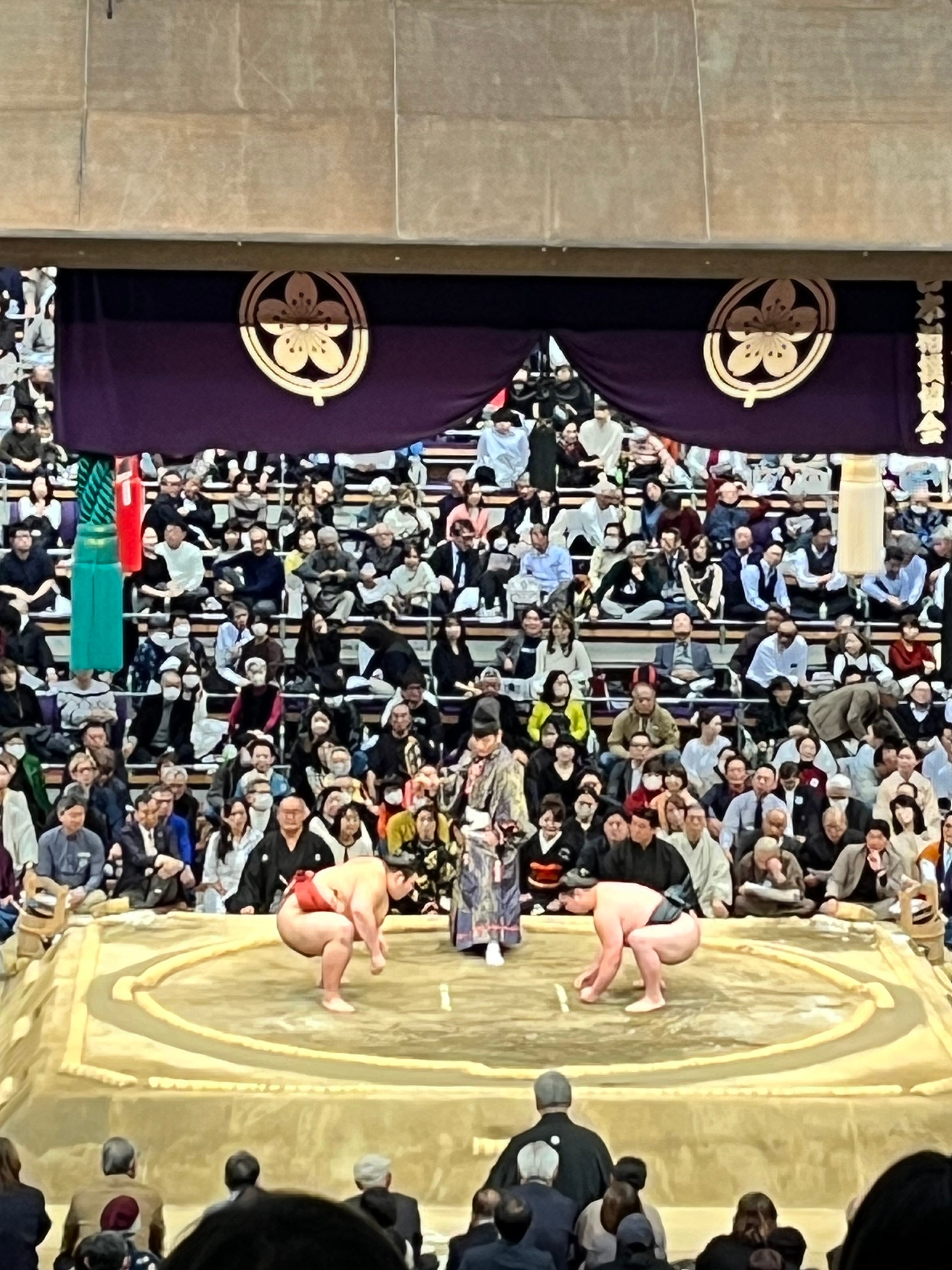
In one old Sazae-san comic strip, I remember Namihei hurrying home from work during a sumo tournament, almost trotting, so that he would not miss the broadcast.
I understand him completely.
There is also a song by Akiko Yano that evokes the sound of sumo on television in the house. For many people in Japan, that sound was not simply the sound of a sports broadcast. It was the sound of evening itself.
In the actual arena, a day of sumo begins much earlier. The lower-division bouts begin in the morning, and the bouts continue steadily throughout the day. By the time the top-division wrestlers appear, it is already late afternoon. The makuuchi ring-entering ceremony usually takes place around 3:40 p.m., followed by the yokozuna ring-entering ceremony, and the top-division bouts lead toward the final match of the day. By around 6 p.m., everything comes to a close.
This is why, for many people watching at home, sumo belongs to the hours between late afternoon and evening.
NHK’s sumo broadcast often fills that time between about four and six o’clock. It is the sound that enters the house after school or after work, before dinner is ready. Children may be doing their homework. Someone may be cooking in the kitchen. The light outside is beginning to soften. In the background, the sounds of sumo continue. For me, the sound of sumo is inseparable from that hour of the day.
The Sounds of Sumo
The sound of sumo begins with drums. Even through the television, the taiko does not feel like background music. It feels like a threshold. There are drums that gather people, drums that mark the beginning, and drums that send everyone home at the end of the day.
Then comes the dry, clear sound of the wooden clappers — ki, as they are called in sumo.
Kan, kan.
To me, this is the sound of transition.
Now we begin. Now we move to the next moment. Now this part has come to a close.
When I hear that sound, even through a television broadcast, I feel the scattered attention of many people briefly gather into one line, drawn toward the dohyō.
Then comes the voice of the yobidashi.
“Higashi—”
“Nishi—”
East and West.
The yobidashi calls the names of the wrestlers in a long, chant-like voice. This is not simply an announcement. It feels more like an invitation. A wrestler’s name is not merely read aloud; it is called into the space of the dohyō.
As a Shinto priest, this feels familiar to me. In norito, too, when we read the name of the person for whom we are praying, we do not say it in an ordinary speaking voice. The name enters the rhythm of the prayer. It is given a tone, a cadence, a place within the ritual language.
There is also the voice of the gyōji, the referee.
Hakkiyoi.
Nokotta, nokotta.
These words keep the bout alive. When the movement pauses, hakkiyoi urges the wrestlers onward. When the struggle continues, nokotta tells us that both wrestlers are still in the ring, that the match has not yet been decided.
The more the gyōji repeats nokotta, nokotta, the more the attention of the entire hall is drawn into a single point.
The moment stretches. The bout is still alive. Nothing has ended yet.
Then there are the sounds made by the wrestlers themselves.
The clap of their hands.
The heavy stamp of shiko.
The scattering of salt.
They carry a deep ritual feeling.
The clapping is a gesture of respect toward the dohyō itself. The salt purifies. The shiko presses the feet into the earth, as if calming and strengthening the ground beneath them.
Of course, sumo is a sport. The wrestlers are athletes of extraordinary strength and skill.
But before the clash of bodies, there is always this sequence of gestures.
Clapping.
Stamping.
Scattering salt.
Crouching.
Waiting.
The body is prepared.
The space is prepared.
The air is prepared.
Then, suddenly, everything changes.
There is the silence just before the initial charge.
A held breath.
Then the sound of two bodies colliding.
Even through the television, that sound can be startlingly raw. In that instant, the ceremonial atmosphere becomes physical. The ritual space becomes a place of flesh, force, balance, and danger.
This, too, is part of sumo’s richness.
It is not pure solemnity. It is not pure sport. It moves between the two.
For those of us watching at home, there is another layer: the calm voice of the NHK announcer, the low voice of the retired elder offering commentary, the murmur of the crowd, and the brief post-bout interview in which a wrestler, still breathless, often says very little.
Sometimes he has just won a great match, but he does not look especially triumphant.He answers quietly, almost shyly. I love that too. The emotion is there, but it is held within form.
Perhaps that is why the sounds of sumo remain in the memory so strongly. They are not only the sounds of a sport. They are the sounds of attention, transition, respect, struggle, restraint, and return.
They are the sounds of evening.
For many of us in Japan, they are also the sounds of home.
When the Sound Became Air
For a long time, sumo lived in my memory this way.
It came to me through the television, from somewhere slightly distant: the Kokugikan in Tokyo, the tournament hall in Fukuoka, or another arena filled with voices, salt, drums, and waiting bodies.
I heard it while sitting at home, while doing homework, while dinner was being prepared, while the light outside slowly changed.
But later, I would go to see sumo in person.
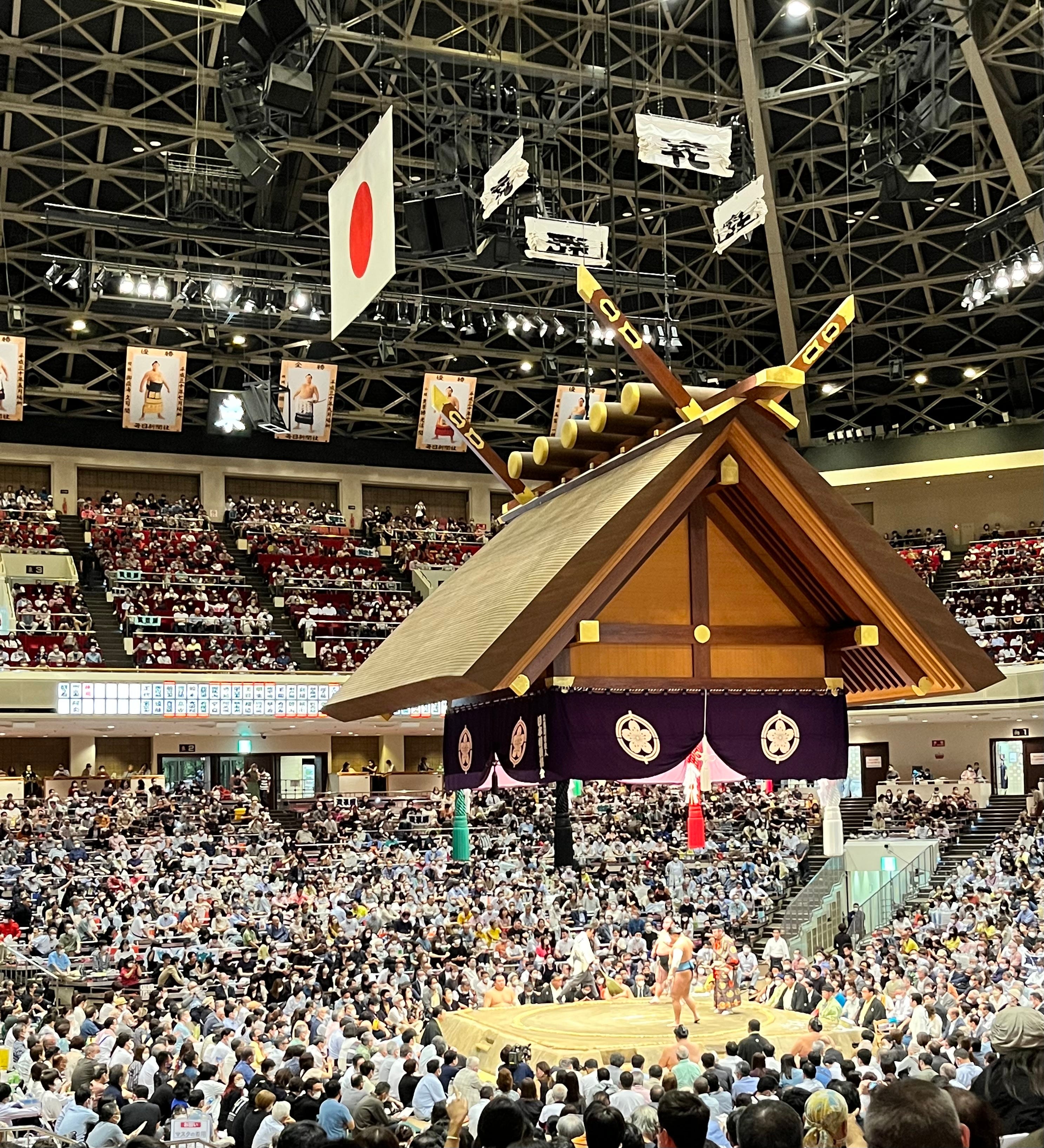
I would sit inside the Kokugikan.
I would hear the drums not through a speaker, but in the air around me.
I would feel the wooden clappers cut through the hall.
I would see the wrestlers step into the dohyō not as figures on a screen, but as living bodies, enormous and strangely graceful.
I would understand something I could not fully understand from television alone. But that is a story for next time.
For now, I want to stay with the sound of sumo as it first lived in me: the sound of evening, the sound of home, and one of Japan’s most powerful forms of living nostalgia.
I became interested in sumo because my sister was, and I wanted the challenge of not seeing the wrestlers as grotesque. I came to appreciate it, even to become a fan. I visited Japan two years ago, and was able to attend a morning practise session at one of the heyas. When I first entered the practise room I was truly awestruck: the wrestlers were giants. Their ease with their mostly naked bodies, the quiet work, punctuated only by “yosh” as they moved from one exercise to another, their absorption in their task, were very moving, so that tears came to my eyes. Your writing brought it back so vividly, it was indeed a shared nostalgia. Thank you.
Congratulations on the first year! It is wonderful to be able to read it all!
The nostalgic feeling we get, I think it's a cross-cultural thing. People long for a place of quiet of mind and I think that how Shinto provides it, it clicks with a lot of us. It's on the little details of everyday life that we can enjoy.
It's been the third Basho I'm following. I think I'm starting to understand what you say as it's the sound of the evening. Sumo is a perfect sport to watch while also doing something else, since the time between bouts it's fairly long and you can actually listen at which moment of the bout you are. As someone I know says, it's the perfect sport to have in a second monitor while working.
But I'm enjoying it more and more. Not only watching those mountains of rikishi competing, but also the rituals, gyoji and yobidashi.
I've come to like a lot Kotoheiho's Shiko. It looks so elegant. Yobidashi's call like Kunio's are just fantastic to listen. And Limits Konosuke looks so authoritive at the doryou.
I still remember when I first watched some bouts, a long time ago: it was on a famous old capsule hotel (green capsule hotel, I think it's name. It also appeared on one beautiful documentary movie called Baraka (or maybe it was Samsara...)bath in Shinjuku, on my first trip to Tokyo. I remember my feeling at the time: "it feels like I'm in a movie by itself: being on a big bath pool alone with some strangers, away from home, while watching a sport that is totally new for me"
Now one of my wishes is that I can soon watch a tournament day live :D