


When I was in fourth grade—yes, exactly that age when boys would come to school in summer wearing swimming goggles—I fell off the stage in the school gymnasium and broke one of my front teeth.
This did not happen in the middle of some ceremony, or during a concert. It happened during the ordinary lunchtime cleaning period.
I was a mischievous child, and I had been playing sword fights with the boys on the stage, using mops and brooms. Suddenly, I made a declaration:
“If I can walk to the edge of the stage with my eyes closed, I will become president of the student council.”
Then I did it.
I failed to stop at the edge, fell straight off the stage, and broke my front tooth.
Unfortunately, it was a permanent tooth.
Because the accident happened at school, the school insurance covered the treatment, and my front tooth became a plastic artificial tooth.
More unfortunate still, the completely innocent boys who had merely happened to be there were severely scolded by the teachers, and their parents came to my house carrying boxes of sweets to apologize.
***
Susanoo had cried because he wanted to see his mother, Izanami, in the land of Yomi, and had rejected his father Izanagi’s instruction to rule the sea. His father therefore expelled him.
Susanoo then decided to go to Takamanohara, the Plain of High Heaven, so that he could say one word of farewell to his older sister Amaterasu before leaving.
But this was someone whose sheer power, through crying alone, had caused all the trees on the mountains to wither and the waters of the seas to dry up. When he began ascending to heaven at tremendous speed, it was as though an earthquake of magnitude one thousand had struck. The mountains and rivers shook violently, and the entire land was thrown into chaos.
When Amaterasu received news of this, she assumed that Susanoo was storming into Takamanohara to attack it, and made the decision to arm herself and fight.
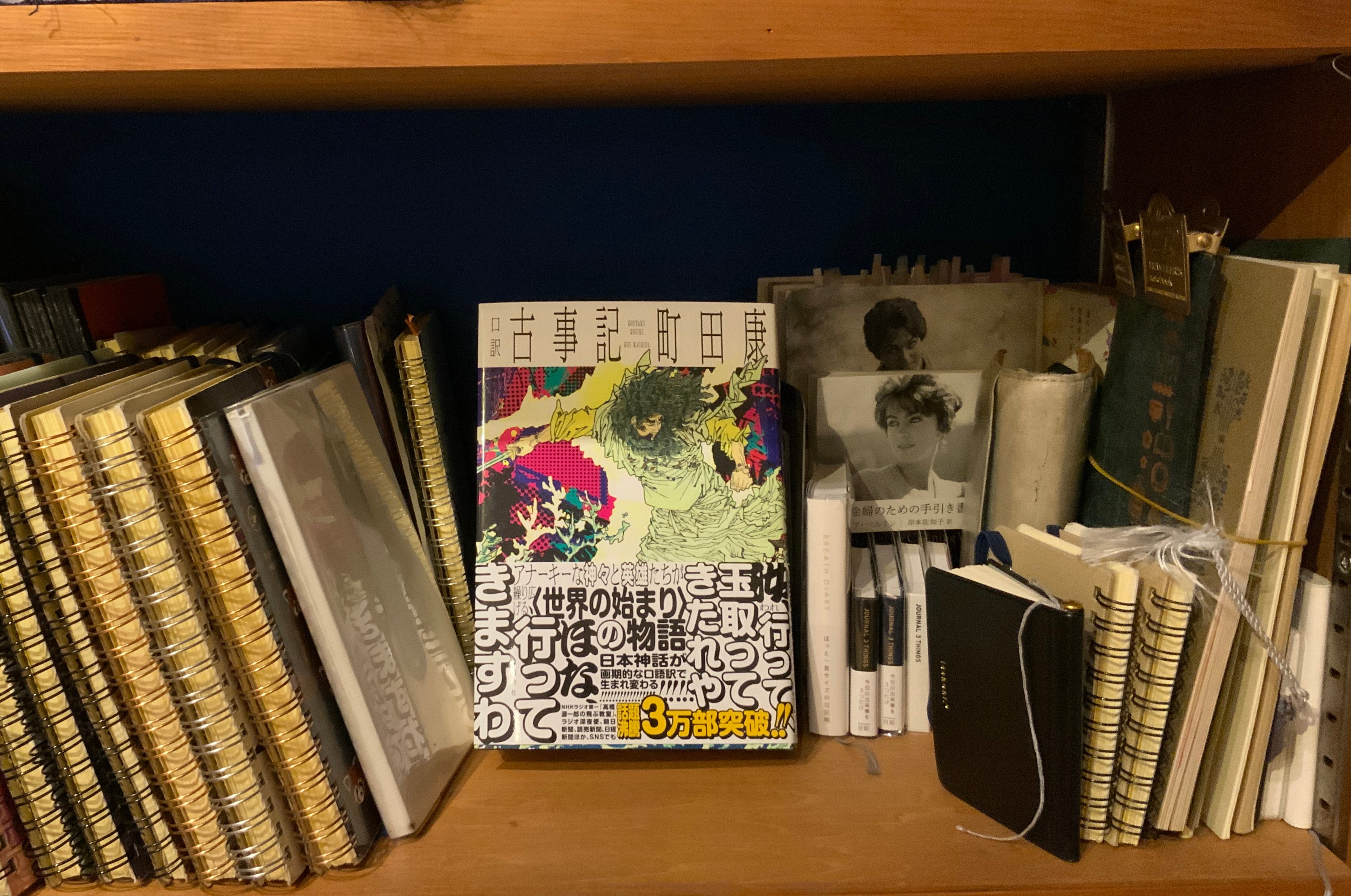
From here, I am going to take the liberty of translating and quoting from Kōyaku Kojiki (A Colloquial Translation of the Kojiki, Kodansha, 2023), by Kō Machida, one of my favorite writers, who is also a punk rocker.
“Amaterasu loosened her long hair and arranged it into mizura—bundles of hair wound and tied on both sides of her head. Around both arms she wrapped necklaces threaded on extremely long cords, fitted with super-powerful power stones.
She put on armor and strapped a case for arrows onto her back. Incidentally, this case held one thousand arrows. Another arrow case was attached to the chest of her armor, and this one held five hundred arrows. On her left wrist she fastened a massive wristband.
Now in full armor, she ran screaming down the steps of the palace and landed in the courtyard.
UOOOOOOOOOOOH!
She raised her left leg high and stomped down on the extremely hard ground.
The force was so tremendous that her left leg sank into the earth all the way up to her thigh.
Again she cried,
UOOOOOOOOOOOOH!
She raised her right leg high and stomped down on the extremely hard ground.
The force was so tremendous that her right leg, too, sank into the earth all the way up to her thigh.
Then she screamed,
DARAAAAAAAAAAAH!
and kicked upward, sending chunks of the hard ground flying through the air as though they were snow.
At the exact moment Amaterasu’s excitement reached its maximum, Susanoo arrived in Takamagahara and came before her.
Still in a state of extreme agitation, Amaterasu demanded,
‘What is this? What are you doing here? Are you looking for a fight? What exactly are you planning?’
Susanoo replied,
‘Please calm down a little. When I was crying, the great kami Izanagi asked me, “Why are you crying?” I answered, “I am crying because I want to go to the land of my mother, Ne-no-Katasu-kuni.” Then the great kami said, “You shall no longer remain in this land,” and I was expelled.
So I have come here simply to report this to you. I have absolutely no intention of rebellion.’
Amaterasu said,
‘Words are convenient. Anyone can say anything with their mouth. How am I supposed to know that you harbor no hidden intention? There is no possible way for me to know.’
There was no means of proving that Susanoo had no ulterior motive. Therefore, there was a possibility that he did. Therefore, she would strike him down.
That was what remained unspoken.
Susanoo responded calmly.
‘Very well. In that case, let us perform an ukehi.’”
***
What is an ukehi?
At this point, the book gives the following supplementary explanation.
For example, imagine a man standing in front of a huge rock with a sword raised above his head.
“If I am an idiot, this sword will break,” he says.
Then:
“If I am clever, this rock will split.”
He gathers all his strength and smashes the sword against the rock.
The rock will either split, or the sword will break.
The result determines whether the man is an idiot or clever.
That is roughly how it works.
Now, if someone hears this explanation and says, “Ah, I see. So ukehi is a way of determining whether someone is an idiot or clever,” that person is an idiot.
The point is not that.
As the words “for example” indicate, an ukehi is performed in order to determine whether something is true or false. What that “something” is changes according to the situation.
In this particular case, the ukehi is performed to determine whether Susanoo truly means what he says when he declares that he has no intention of rebellion.
***
Leaving Kō Machida’s Kōyaku Kojiki for a moment, let us return to me in fourth grade.
A perceptive reader may already be thinking that what I did in fourth grade was perhaps a kind of ukehi concerning whether or not I would become president of the student council.
I think so too.
At the time, I told neither my teachers nor my parents how the accident had actually happened.
The reason was my expectation that adults would say something like this:
“There is no causal relationship whatsoever between walking to the edge of a gymnasium stage with your eyes closed and becoming president of the student council. Why would you do something so stupid?”
Yet those adults, too, must surely have done similar things as children.
“If I can get all the way home stepping only on the white lines, I will become prime minister.”
“If I can skip this stone three times across the water, I am a genius.”
“If the next dog I pass is a Shiba Inu, we are in love with each other. If it is a black Shiba, my love is unrequited.”
Surely they did things like that.
There is a structure here:
“If A, then B.”
The less connection there is between A and B, the more truth seems somehow to inhabit the relationship.
The more it seems that divine intention may be present there. As children, perhaps all of us possessed this feeling.
With the gradual acquisition of the ability to live properly in society, however, perhaps it is something we lose.
The world of myth preserves this primal sensation in all its freshness.
That may be why myths attract our hearts even when we do not understand what they mean.
***
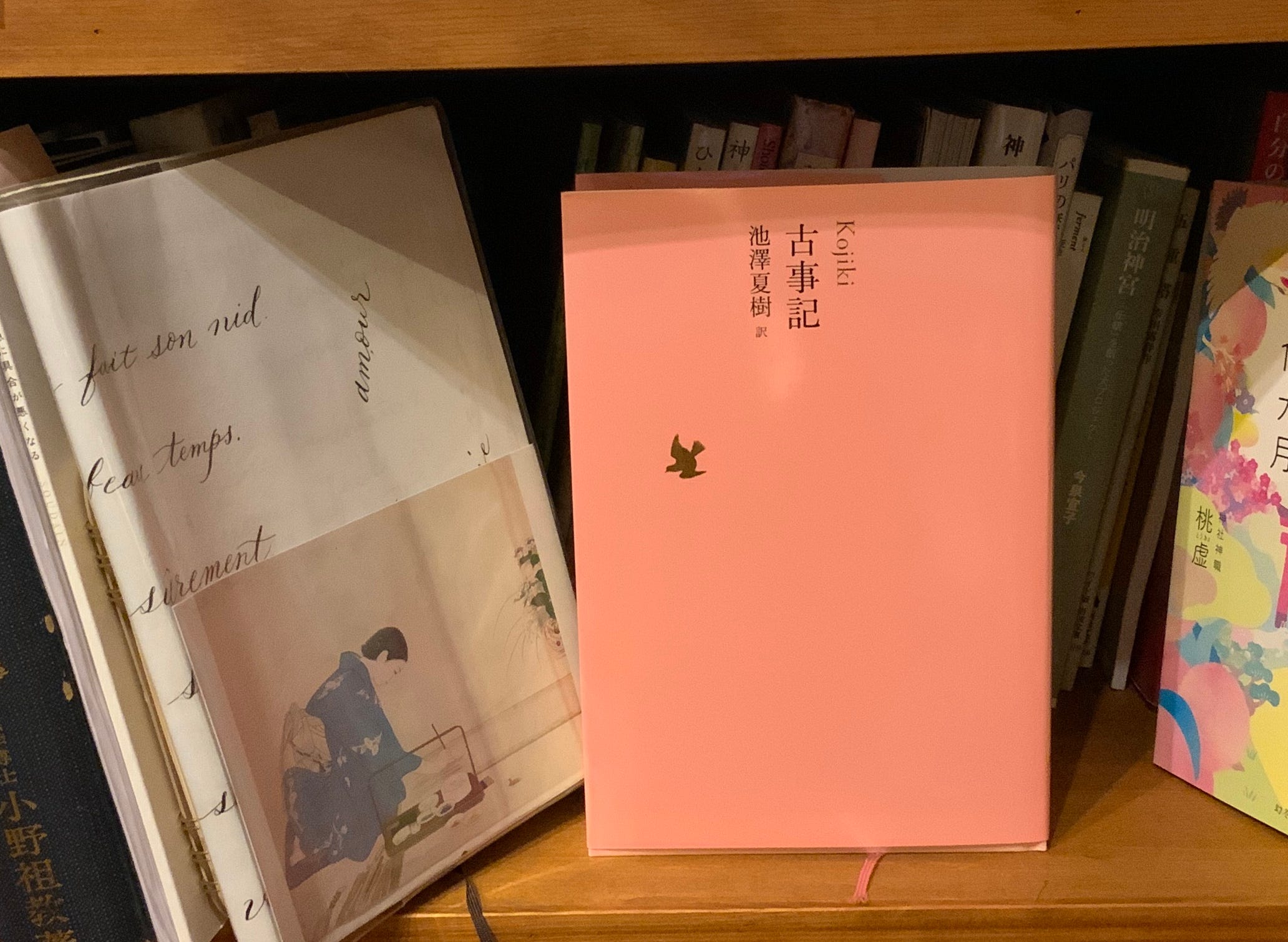
Now, for the continuation of the Kojiki, I will also refer to Natsuki Ikezawa’s modern Japanese translation of the Kojiki (Kawade Shobo Shinsha, 2014), giving you a moderately condensed English version.
Amaterasu asked Susanoo:
“How can we make it clear that you have no hidden intention?”
Susanoo replied:
“Let us make a vow and produce children.”
The two therefore stood on opposite banks of the Heavenly Yasu River and agreed to produce children after making their respective vows.
Amaterasu told her younger brother Susanoo to hand over the Totsuka-no-Tsurugi, the sword hanging at his waist.
She broke it into three pieces, purified them in the water of the Heavenly Well of Mana, chewed them until they made a pleasant sound against one another, and blew them out in a breath.
From the mist-like breath were born:
Takiribime-no-Mikoto, also known as Okitsushimahime-no-Mikoto.
Itsukishimahime-no-Mikoto, also known as Sayoribime-no-Mikoto.
Takitsuhime-no-Mikoto.
Three in total.
Susanoo then asked Amaterasu for the Yasaka-no-Iotsu-no-Mizumaru wound around the mizura on the left side of her head—the things I described earlier as power stones.
He purified the jewels in the water of the Heavenly Well of Mana, chewed them until they struck one another with a pleasant sound, and blew them out.
From the mist-like breath was born:
Masaka-Akatsu-Kachihayahi-Ame-no-Oshihomimi-no-Mikoto.
Next, he asked for the jewels wound around the mizura on the right side of her head, chewed them, and blew them out.
From the mist-like breath was born:
Ame-no-Hohi-no-Mikoto.
He chewed the jewels wound around her hair ornament and blew them out.
From the mist-like breath was born:
Amatsuhikone-no-Mikoto.
He asked for the jewels wrapped around her left hand, chewed them, and blew them out.
From the mist-like breath was born:
Ikutsuhikone-no-Mikoto.
Finally, he asked for the jewels wrapped around her right hand, chewed them, and blew them out.
From the mist-like breath was born:
Kumano-Kusubi-no-Mikoto.
Five in total.
At this point, Amaterasu said to Susanoo:
“The five boys born later came from my possessions, so they can be called my children. The three girls born first came from your possession, so they are your children.”
In this way, she established to whom each child belonged.
Susanoo then said to Amaterasu:
“Because my heart is pure and bright, gentle women were born. On that basis, I have won. Is that acceptable?”
“That is fine,” Amaterasu replied.
The instant she said this, Susanoo’s behavior changed.
Proud of his victory, he began doing whatever he pleased.
***
Susanoo’s outrages after this point are famous, so I will give you only a shortened version.
He destroyed the ridges around Amaterasu’s sacred rice fields and scattered enormous quantities of excrement in a sacred place.
Amaterasu responded:
“The excrement—well, perhaps my younger brother Susanoo got extremely drunk and thought it might be amusing to do something like that. As for destroying the ridges and filling in the irrigation channels, perhaps he was only trying to increase the amount of usable land.”
Having witnessed the result of the ukehi, Amaterasu did not condemn Susanoo.
Susanoo’s rampage therefore became increasingly bold, eventually causing Amaterasu, the kami governing the sun, to shut herself inside the Heavenly Rock Cave and plunge Takamanohara into complete darkness.
***
If you have never sacrificed one of your front teeth for an ukehi, you may have a few questions by this point.
I would like to end this installment by answering them in my own way.
Q1. “How does the birth of goddesses from your possessions prove that you have no rebellious intention?”
Susanoo calls the goddesses taoyame—gentle, delicate women. Perhaps he means that their softness reflects the nature of his own heart.
With ukehi, the person performing it gets to decide the conditions.
The stranger the connection, the better.
Q2. “Why does Amaterasu, who was absolutely furious only moments earlier, accept the result of the ukehi so readily and stop blaming Susanoo?”
I think Amaterasu saw her own rage and aggressive energy as the reason the male kami were born from her possessions during the ukehi.
Susanoo’s heart, meanwhile, had produced gentle female kami.
His claim that he harbored no ill intent did not appear before her merely as words. It appeared in the form of kami.
I think that left her stunned.
My sense is that this may be why, even while Susanoo began doing whatever he pleased, Amaterasu kept herself from becoming aggressive again and stayed in that stunned state.
Q3. “Susanoo himself said that he had no rebellious intention and that his heart was pure and bright. Isn’t it strange that he then goes completely wild?”
I feel that having no rebellious intent and having a “pure and bright heart” are not the same thing as being good.
Susanoo seems to think:
“How amazing would it be if I completely destroyed this? Probably extremely amazing.”
Then he does it—not because he wants to rebel or seize power, but for the sheer thrill of doing something outrageous. In that sense, his heart remains untouched by ulterior motives.
The problem is that his power is enormous, so the people around him suffer the consequences.
His joy at winning the ukehi simply turns into another pure impulse:
“I want to do something amazing.”
From the Nara period onward, kami worship and Buddhism gradually became intertwined in Japan. Temples and shrines complemented one another, while the balance between them shifted over time.
At certain points in history, Buddhist monks even recited sutras to kami and encouraged them to perform good deeds. That gives some sense of how far outside human ideas of good and evil the kami can stand.
We Shinto priests make offerings to the kami and dedicate music and dance to them. In a sense, we entertain them and try to keep them in a good mood.
Perhaps this also serves to turn the attention of the kami away from mischief—“mischief,” of course, only from the human point of view.
✳︎✳︎✳︎
The second installment of the Susanoo series was about his ukehi with Amaterasu.
Next time, Amaterasu will finally shut herself inside the Heavenly Rock Cave, and Susanoo will be cast down to the world below, where he will fight Yamata-no-Orochi.
I am not sure whether I will actually manage to get that far!
If you have ever had an experience that makes you think, looking back now, “Oh, that was actually a bit like an ukehi,” please tell me about it in the comments.
A little update on my left front tooth: once I was an adult and earning my own money, I finally upgraded it to ceramic!
Aloha from Hoek Van Holland! Your example of ukehi breaking a front tooth instantly brought back memories of myself in 4th grade returning from an overnight stay in our treehouse deep in a 300 acre forest in Oregon. I had a sleeping bag over my head and was being verbally guided by a friend. I mistakenly turned right instead of left into a brick wall breaking my right front tooth in addition to uprootinng my lower front teeth. Luckily my friend's father was a dentist who lived across the street and he performed emergency dental work. Thankfully I was wearing braces which helped save the lower teeth and the temporary crown on the broken front tooth is still in place 6 decades later! Learned quite a few lessons from this experience which maybe can be called ukehi. In my way of thinking, we believe that we are conceived with 100% energy connection which means 100% intuitive powers. Gradually as we age, we lose that 100% energy connection through various lifestyle choices, although with certain practices we can slow it down or even increase it (our QiGA energy connection development program is focued on this goal). We have a meeting with the 80 year old founder/chief priest of the Shinto Shrine in Amsterdam on 9/24. We believe this is the first Shinto Shrine in Europe with the second one being established later in San Marino. We hope to visit it as well before returning to Japan 10/13. Thank you for your AMAZING wandering mind shares....always beneficial for Noriko and I to discuss and reflect on.